
The Value of a Commute
A Speculative Design Project for 2035 — Embedded in Today’s Commute
In its simplest form, transportation is a way to get from Place A to Place B. But it’s so much bigger than that, connecting to our health in many ways:. How we get from A to B can affect how much physical activity we get; the amount of time we spend outdoors exposed to daylight; how we experience our communities; how we interact with others; and the mark that we leave on the planet. The US has been traditionally auto-centric: many communities have evolved to prioritize transportation by private automobile, making that option people’s default mode, bringing both benefits and a host of health and environmental consequences. The near future of transportation could be much more diverse — e-bikes, e-scooters and robotaxis are recent alternatives and flying cars might not be far behind. With all of these modes, the future of transportation infrastructure is an open question: will it continue to privilege less healthy modes of transportation or could it make more active, more social modes more viable?
With the help of designer Elliott Wortham, we sponsored a capstone project to develop a speculative design on this topic for a team of graduate students from the Master of Science in Human-Centered Design and Engineering program at the University of Washington.
The team did a deep dive on transportation — its past, present and future — and came up with a systems perspective for understanding it. They linked the individual, moment-by-moment commuting decisions people make to their aggregate effect on community design and infrastructure more broadly. They identified a feedback loop: the existing infrastructure typically makes driving alone the easiest option, so more people choose it, which serves to reinforces that infrastructure, which makes it the easiest option, and so on. Using their local context of Seattle, they chose to intervene in that loop by challenging people to think beyond the fastest way to get from A to B and instead reflect on the potential value of a commute — what else it could bring to one.
You can join the team in that reflection, review their learnings, and learn how they approached the problem by checking out the work products below.
Work Products
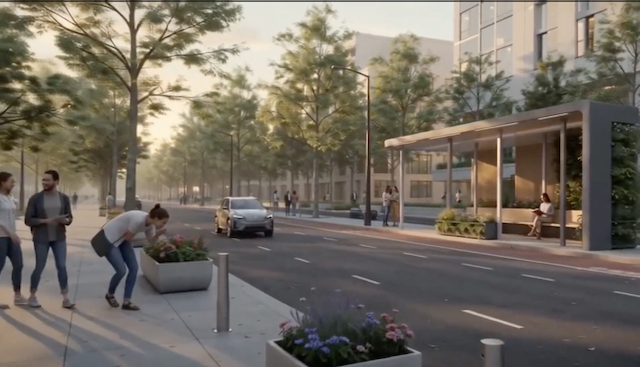
PROJECT oVERVIEW Video
Watch a 3-minute overview video of the project, covering the challenge, their findings and what they built.
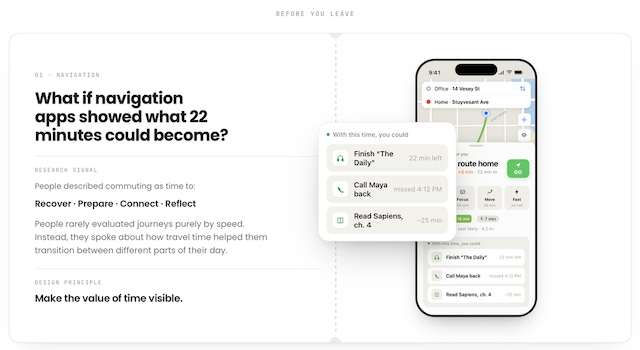
PROJECT WEBSITE
The team built a website that invites you to reflect on what you want from a commute, shows the bigger impact of your small decisions, and invites to you to see the challenge from three perspectives: a commuter; a designer; and a policymaker.
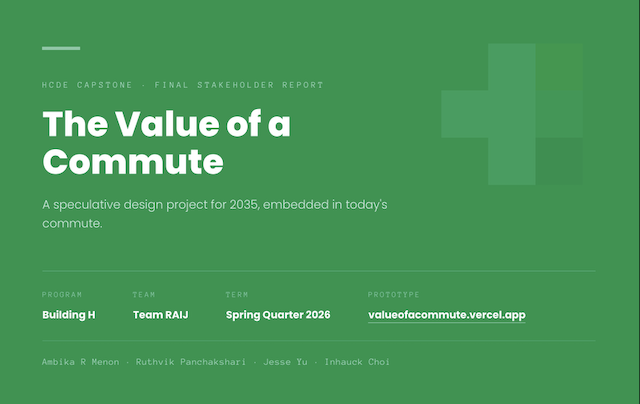
FINAL STAKEHOLDER REPORT
Read a high-level overview of the project, a narration of the way they understood the challenge, what they learned, what they built and thoughts for moving forward.
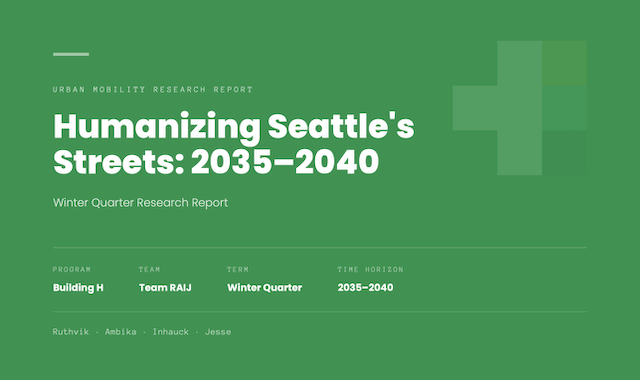
Research OVERVIEW
In this initial research report, the team dived into the subject with secondary research and expert interviews. See what they learned.
Process Book
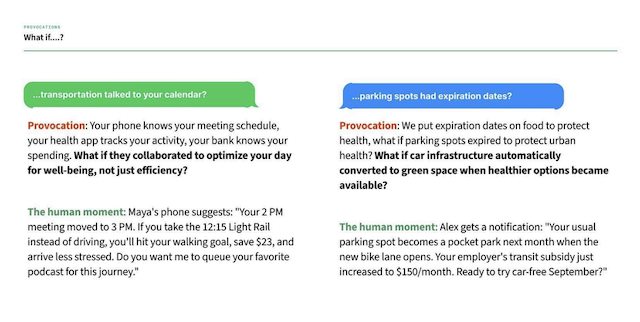
The process book takes you through the team’s activities, the tools they used and, importantly, their thinking as it evolved through the project.
POSTER
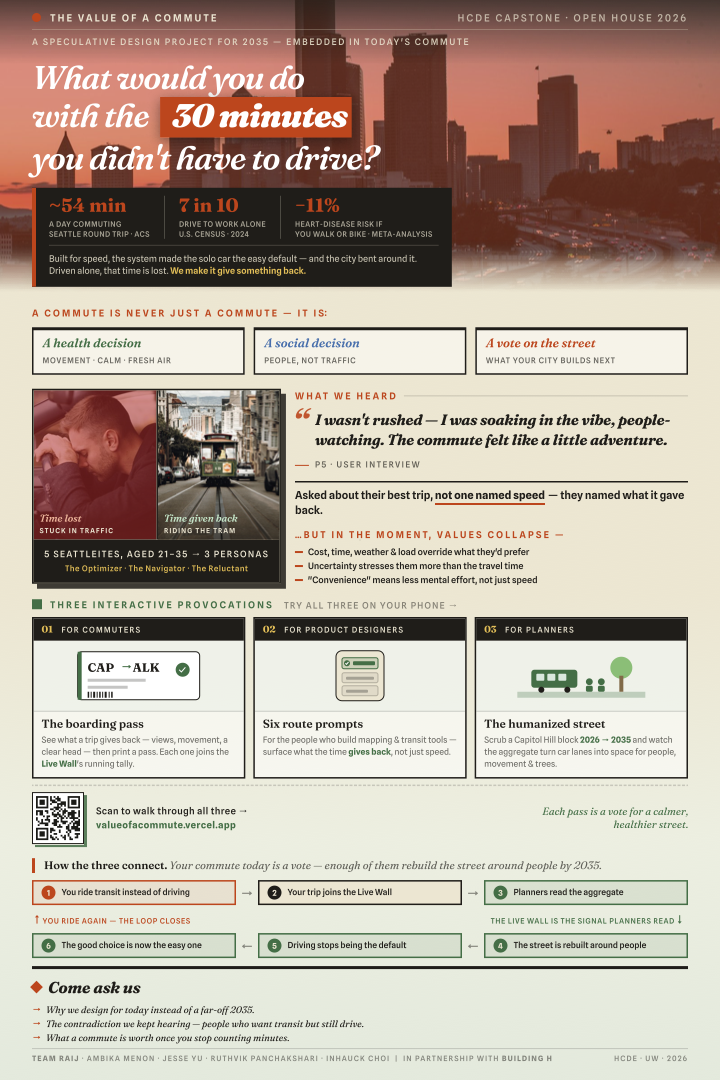
See — and share — a summary of the project in the team’s poster.