
Newsletter | Use Your Words
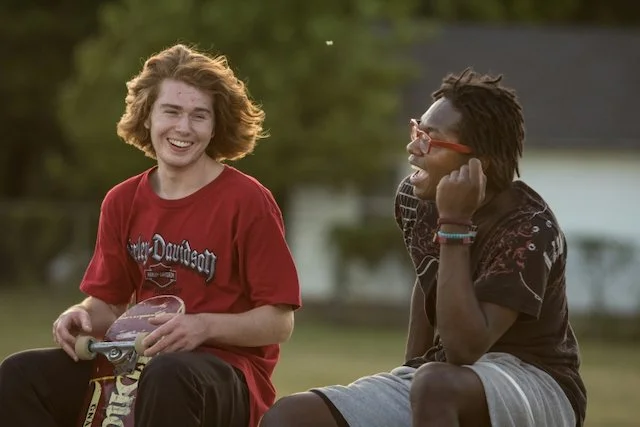
Photo by Simeon Jacobson on Unsplash
People speak, on average, nearly 13,000 words a day. That seems like a lot, but, according to a new study, it actually represents a 28% decrease from the nearly 16,000 per day we spoke in 2005. The authors, Valeria Pfeifer and Matthias Mehl, found that we’ve been going through a steady decline – losing 338 words per day each year – from 2005 to 2019. It’s an interesting piece of work, pooling the results of 22 different studies that used passive ambient audio sensing to capture dialogue of participants around the world (mostly in the US, though) and across all age groups. As the authors note, what’s interesting is to step back and take a long-term view of a phenomenon that, year-by-year, might not seem so dramatic. Also note that this decline precedes COVID-19 and few would argue that the years since are likely to have reversed the trend.
The study doesn’t provide clear explanations, but one hypothesis they investigate is the rise of digital communication. They test this hypothesis in part by segmenting the results by age and finding that people under 25 saw a larger decline (44% more) than those 25 and older. So there is an age divide that could suggest a role for increased digital vs. spoken communication, but it doesn't explain the overall trend.
Another possible contributor has to do with the phenomenon that Americans are, on average, spending more time at home and more time alone. These trends are noted by Derek Thompson, in his recent analysis “If America's So Rich, How'd It Get So Sad?” Thompson cites a wonderful paper by Patrick Sharkey that delves deep into data from the American Time Use Survey in order to unpack the changes in time spent at home and time spent alone. (In part, the trends result from shifts in the activities people choose and shifts in the locations of some of those activities (i.e. from outside of the home to within the home). It’s not news that the last 20 years or so of tech have enabled a whole host of activities to move into the home – shopping, restaurant meals, work, school and social interactions all come to mind – and these have all accelerated since the Pandemic. Many of these activities are simply much more convenient to experience from home.
The social structure of households is also changing. The average household size is now 2.50, a nearly 5% drop since 2000. And the number of single-person households is up to nearly 30%, a 16% rise since the turn of the century. So that added time at home, for many people, is time with less conversation.
We’re also seeing a rise in the replacement of human conversation for efficiency’s sake. Quick service restaurants shunt their customers to their apps to submit their orders ahead and/or install automated kiosks for ordering inside the restaurants. Drive-thrus are experimenting with replacing teenagers with AI voices to take orders and delivery robots are starting to replace DoorDash drivers. And don’t get us started on robotaxis.
The study did not track how many of our daily spoken words are directed at family, friends, co-workers or strangers, nor did it track whether we were even speaking with other humans. But future studies might wish to as we suspect that the nonhuman conversations in particular don’t nourish us in quite the same way.
Which brings us to why this drop in spoken words matters. First, Pfeifer and Mehl argue that spoken conversation is qualitatively different from typed conversation. That live conversation can elicit benefits that don’t necessarily accrue from more words on a screen. Second, one can imagine – and we all seem to be witnessing – how reduced socialization can lead to social avoidance and before you know it, people are choosing to ride in Waymos because they can evade the potential awkwardness of talking or not talking to a human behind the wheel. This vicious cycle can then be exacerbated by the products that substitute for human interaction. We pathologize loneliness and then alleviate it by offering AI companions. They can salve the pain of loneliness, while also promoting and accelerating the conditions – lack of everyday connection and relationships – that create it in the first place.
As we've noted before, modern life can make it challenging to get enough human contact in our lives naturally, and so we have to work harder for it. We have to train ourselves to seek it out, rather than to take the increasingly easier path of avoiding it. A few years back, then Surgeon General Vivek Murthy spoke about a new habit he was trying to establish. When he got a call from someone at a bad time he would answer it – rather than letting it go to voicemail – even just to say it was a bad time and he’d call them later. That voice-to-voice contact – that moment of connection, however brief – mattered.
Pfeifer and Mehl’s research give us useful perspective – they show a long-term trend that is structural and, even if inadvertent, is essentially baked in unless we act. Unless, as individuals, we choose human contact over convenience. Unless, at systems level, we start designing to promote human interaction instead of designing for greater efficiency.
Read the full newsletter.