
Newsletter | Loneliness Inc.
It’s now been more than three years since then Surgeon General Vivek Murthy declared that the US is in an epidemic of loneliness. So how are we doing? America’s entrepreneurs definitely got that memo and the national conversation around loneliness and social isolation has spawned a cornucopia of new apps and services. Writing in Vox, Allie Volpe catalogs this bounty: there are apps for renting friends and cuddlers; loneliness coaches; summer camps for meeting people; bootcamps to overcome shyness; AI friend-matching apps; services to bring solo travelers together and co-working spaces. It’s great, of course, to see all of this entrepreneurial energy directed toward a serious public problem. The issue, as Volpe lays out, is that societal problems like loneliness are not always best solved by commercial products – some problems require broader societal efforts. Volpe’s critique focuses on two mismatches, the first of which is demographic. The nature of commercial solutions is that they cost money and many of those she cites are quite expensive, leaving them out of reach for many of the people who might benefit from them. Indeed, loneliness has a socioeconomic slant, with people of lower incomes and less education more likely to experience it. Second is the messy, complex nature of human relationships, which require nurturing and, more to the point, patient investments of time – a requirement often at odds with the quick fix approach of many services and apps.
There are some commercial approaches that reside further upstream and show more promise. In “The Cure for Loneliness May Lie in a Suburban Duplex,” Conor Dougherty writes about new housing developments that are specifically designed to create the kind of neighborhood conditions that bring people together. These developments buck the long-term trend of larger houses, larger lots and promises of more privacy by building denser, walkable communities that promote serendipitous contact among neighbors and foster social connection. In addition to the architecture and landscaping, many of these communities offer programming like events, clubs and meetups. The good news is that there is demand for these communities – people are finding that social connection is worth paying (or sacrificing square footage) for.
Further downstream, there is the emergence of AI friends. In a world where it feels awkward to call a friend at midnight when you’re feeling blue, a sympathetic, always on chatbot who seems to know you very well is an obvious choice. But not necessarily a good one. To delve into the question of whether, in particular, kids should have AI friends, Adam Clark Estes interviewed Anne Maheux, whose team recently completed a study analyzing middle school students’ use of AI chatbots and their mental health. The study showed an association between chatbot use and loneliness, but, more importantly, it observed a directionality to the relationship. Said Maheux, “It’s not just that the lonely kids are using AI, and they’re otherwise unharmed. It is that using AI comes first, and middle school students are increasing their sense of loneliness following the use of AI. In other words, middle school students using AI for emotional intimacy and companionship developed greater loneliness over time.” It sounds like a classic case of treating the symptoms in which the treatment actually exacerbates the problems that cause the symptoms in the first place.
Loneliness, social isolation and social connection are also fairly nuanced concepts and part of the challenge is unpacking their different elements, which can vary in their pertinence to different people. A new report from our friends at the Christensen Institute unpacks some of this complexity, using the “jobs to be done” framework to understand what sort of loneliness people (in this case parents) are experiencing. The report identifies five: depletion/reclaiming time for self; boredom/re-engaging/proving capability; intimate isolation; relational isolation; and collective isolation. These needs are quite different and demand different solutions, which the report explores in some detail.
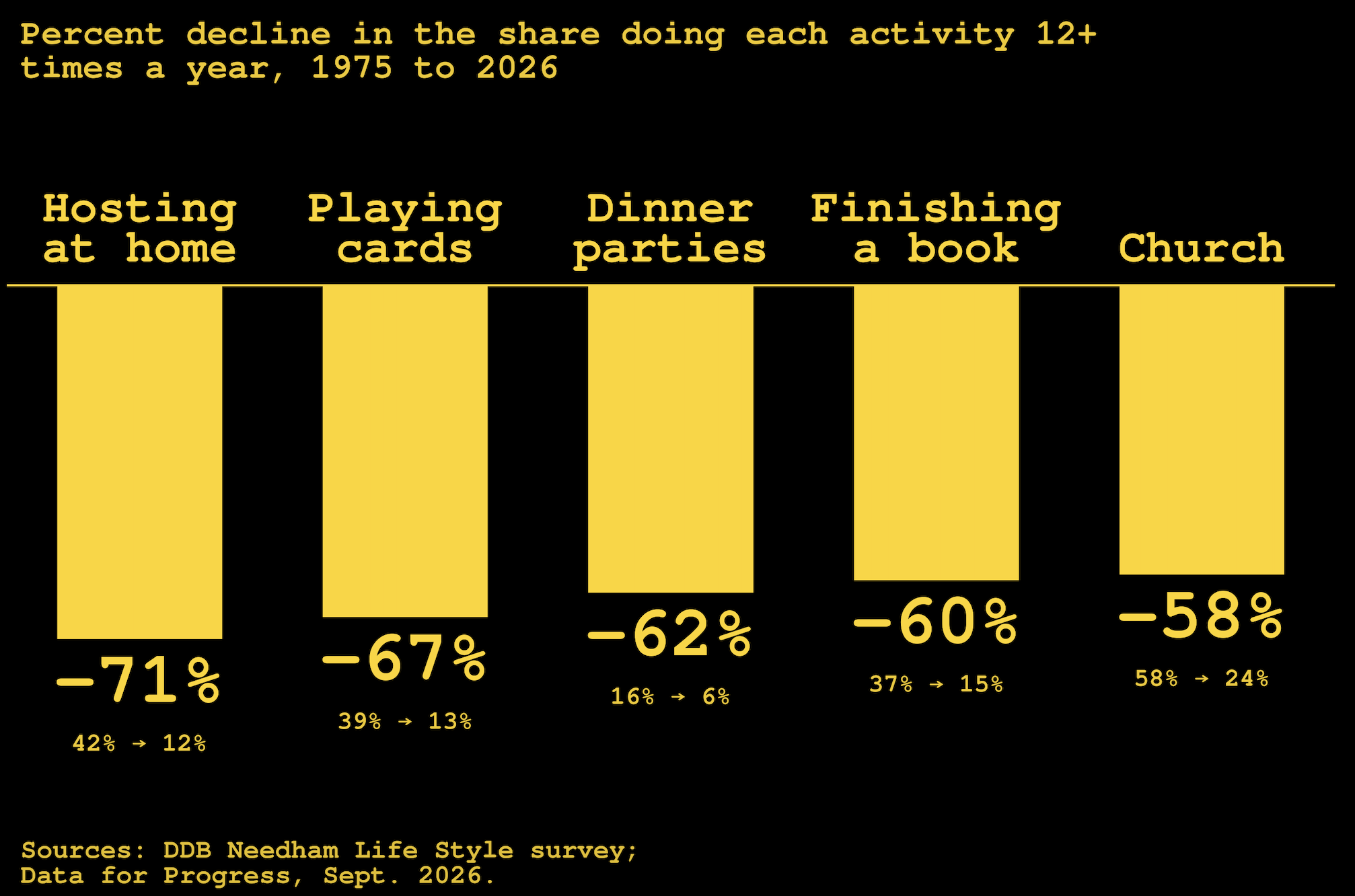
While entrepreneurs rush in with new solutions, it’s important to remember that the crisis of connection did not just blow up on the scene like COVID, but is rather the culmination of some long-term, structural trends that have been going on for several decades now. In You Are No Longer Invited to Dinner, Derek Thompson tracks the demise of hosting, citing the remarkable stat that the percentage of Americans who host family or friends at their home at least once a month has dropped from 42% to 12% (a 70% decline) from 1975 to 2026. Thompson does his best to explain the collapse, citing four related trends: we’re just busier (especially two-worker households); we’re spending more time with our kids than ever; we simply have fewer friends to invite over than we used to; and it’s too much fun to be home alone these days. Of the last point, Thompson writes “cocooned within personalized entertainment fortresses, more Americans have shrunk the vast buffet of all possible leisure activities to the small plate of screened media.”
Julie Beck explores the lure of being at home in her essay for The Atlantic, “One Reason People Are Spending So Much Time Alone.” Beck draws on the new book, Against Convenience, by Gabe Bullard, to explore the tradeoff between convenience and community. She identified countless innovations of convenience, from Pelotons to Ubers, from DoorDash to the Starbucks app, that come with the social cost of avoiding interactions with other humans. Even when we go out, we wind up using the self-checkout line at the grocery store rather than have to converse with a checker. Beck notes how Uber offers an upgrade where you can ask for a “quiet ride” – for an additional fee. What does it say that we are now paying AI agents to
talk with us and paying humans not to talk with us? This notion of technology and innovation undermining human contact is not new – David Byrne’s prescient 2017 essay “Eliminating the Human” made the same observation, but it bears repeating, because, as Byrne pointed out, we appear to be choosing this path rather unconsciously and it comes with a societal cost.
We find ourselves with a lot of energy dedicated to finding solutions to the important challenges of social isolation and loneliness. Some of it is directed at more promising, more sustainable leverage points than others. Meanwhile, we have major structural trends, based in demography and culture, that are, as they often are, amplified and accelerated by technological trends. Finding the balance of downstream "solutions" that address the symptoms and more fundamental upstream interventions and leadership that tackle the deeper trends remains a challenge.
Read the full newsletter.