
Newsletter | Making It Count
In his recent essay Enshittification Relies on Broken Economic Math, the journalist Hamilton Nolan offers a good explainer of the economic concept of externalities and how our willful ignorance of them is degrading our quality of life:
“The way that America’s version of capitalism proves its utility is by adding up all of the profits created by the privatization of public goods without subtracting the value that has been destroyed by the same activity. We have created the largest enshittifying machine in world history by employing a financial logic that leaves out half of the equation.”
Nolan gives the example of billboards, which through their construction and sales of advertising, create economic value. But we never count – nor do we even know how to count – the social cost of the visual pollution they create. It’s this failure, whether in billboards, pollution, or tobacco, that exasperates Nolan:
“It is not news that this form of ruthless, profit-first capitalism is misguided. (The concept of ‘environmentalism’ was created to address this clear gap between economic logic and human survival.) Nor is it news that many of America’s most profitable industries owe their success to a failure to price in their externalities. (Try recalculating the profits of tobacco companies after you make them pay for all of the medical care for people with lung cancer.) The thing that is remarkable, that makes me admire the audacious cleverness of capitalism itself, is that the understanding of these flaws among intellectuals has done almost nothing to engender in the general public, in the ranks of most non-left elected officials, or even in the professional financial commentariat an urgent desire to wave their hands and yell, ‘hold on a minute!’”
We have a similar view on how the product environment – the array of products and services that shape how we eat, sleep, move (or not) and socialize – affects our health. We all know that fast food and 24/7 entertainment and the resulting sedentary lifestyles can lead to a suite of chronic illnesses. And caring for those illnesses creates a societal cost.
But we rarely try to quantify that harm and especially not at the level of an individual company.
So that’s what we did.
Our team of researchers, led by Steve and our advisor and core collaborator Sara Singer, has just published an article in the peer-reviewed American Journal of Health Promotion, in which we estimate the societal costs associated with the products and services of three companies: Burger King, Netflix and Niantic (the original makers of Pokémon GO). We looked at direct healthcare costs only, which leaves out potential indirect costs associated with worker productivity and environmental costs of production and distribution.
And the numbers aren’t small: Netflix was associated with $32 billion in annual costs in the US; Burger King $4.9 billion and Niantic was actually a net positive of $322 million (due to their beneficial impact on physical activity).
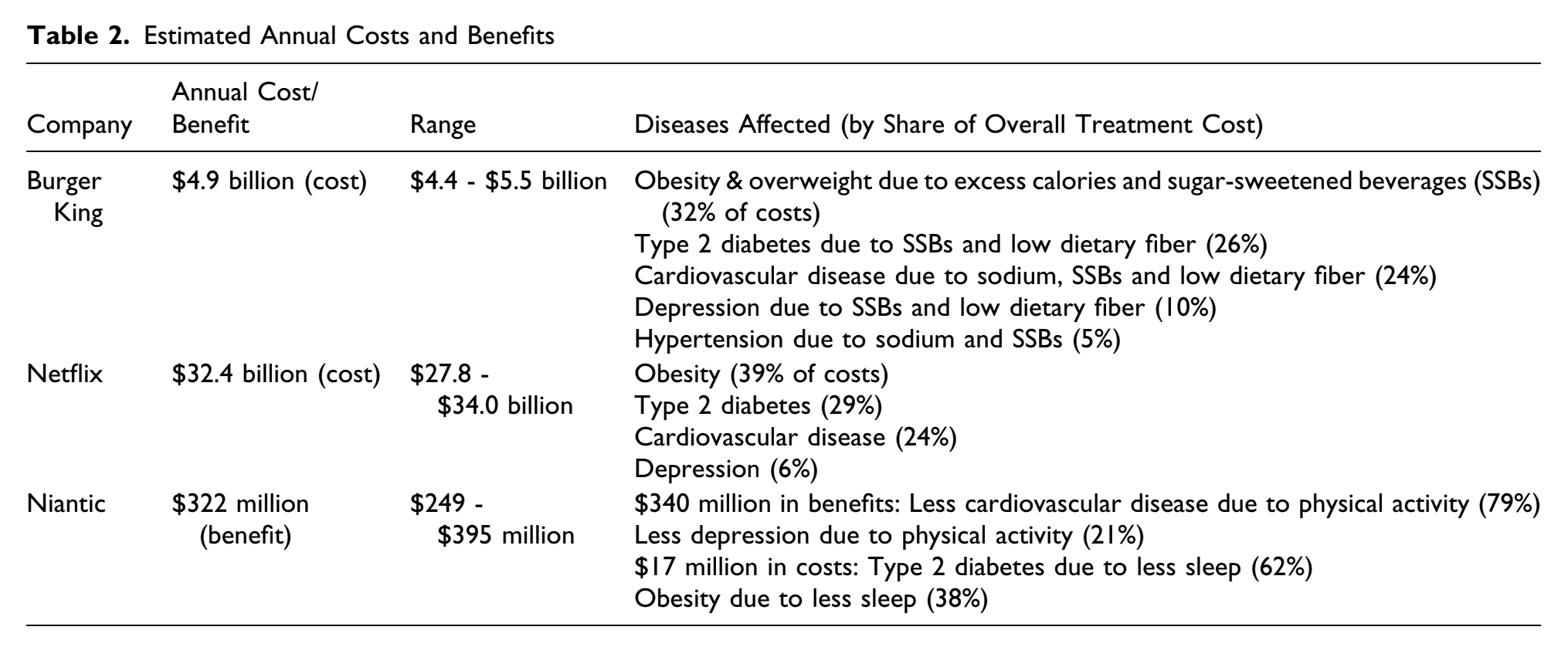
We arrived at these estimates by looking at what we know about the products’ influences on behaviors like physical activity and television viewing and consumption of ingredients like sodium and dietary fiber; how the levels of these behaviors and consumption of these nutrients affects the likelihood of developing cardiovascular disease, depression, hypertension, obesity and type 2 diabetes; and the prevalences and annual costs of treating those diseases. The reasons that the numbers are so large are threefold: the broad reach of the companies; the high prevalences of the diseases; and the high cost of treating them.
The methodology is fairly nascent, but it’s solid and grounded in both epidemiological science and a ton of scientific evidence. It will also get better. The cost figures are just estimates; they rely on a number of assumptions. So they shouldn’t be the main story. The real point is that we’ve taken an abstract concept – that the health influences of products represent an economic externality – and shown that it is both feasible to make these sorts of estimates of societal costs and, given the magnitude of the estimates we’ve done so far, important to do so. The costs are real; they are measurable; and we absolutely should start measuring them more widely.
If you want to dig in, you can see all the details of how we generated the estimates in the journal article. You can also read a write-up of the work by Stanford Health Policy. This was a team effort, with a veritable village of contributors who helped us refine the work along the way. The full list is in our announcement of the work on LinkedIn.
Our aims are to catalyze other researchers to build on the work by applying it to other companies and adapting and refining the methodology and to spur policymakers to start asking the hard questions that should follow.
As always, you can help us out by sharing this work, as many of you have done already. Thank you.
Read the full newsletter.