
Newsletter | Translation Error
“The ‘CVD patient’ is no longer a discrete clinical category but a statistical norm.” This characterization is one of the conclusions from a provocative new paper by Gaetano Santulli, a professor of medicine at City University of New York, who reviews the 2026 American Heart Association Heart Disease and Stroke Statistics Update and puts it in perspective.
Santulli quotes some sobering statistics: when hypertension is included, nearly 49% of American adults have some form of cardiovascular disease, and – even without it – more than 8% have established clinical CVD. The resulting societal cost is $414 billion per year. As he puts it, CVD is now a “defining characteristic of middle and older age in the United States.”
The epidemiological experience of cardiovascular disease is paradoxical. There has been great advancement in the treatment of CVD, resulting in declines in age-adjusted mortality. The flipside of people living longer with CVD is, of course, more years of expensive treatment per person, so the overall cost continues to rise. The other factor is a lack of progress in preventing CVD and, in particular, consistent rises in several of the key risk factors – notably obesity, diabetes and hypertension.
What we have, argues Santulli, is a systems problem. Scientific and clinical research have led to new knowledge, which have made for successful treatments that have transformed CVD from an acute condition to a chronic disease. At the same time, we have been less vigilant about intervening in the risk factors (GLP-1s being a notable exception) and the conditions that generate those risk factors. Santulli calls out a “food environment dominated by ultraprocessed foods” and "misaligned corporate incentives” among the drivers of CVD risk factors. This pattern, of downstream interventions that extend the lifespan of people afflicted with disease, effectively making it somewhat more tolerable as a societal problem, combined with perpetuating – and even passing down from generation to generation – the conditions that give to rise to the disease, is precisely what evolutionary biologist Daniel Lieberman calls “dysevolution.” In dysevolution, the success of the downstream interventions ironically reduces the perceived urgency of the need for upstream, preventive interventions.
Santulli concludes,
“Despite decades of guideline refinement, pharmacologic innovation, and procedural advances, the overall prevalence of CVD continues to rise, upstream risk factors worsen, and healthcare expenditures accelerate. The 2026 update is therefore best interpreted not as a catalog of isolated diseases, but as evidence of a structural failure to translate cardiovascular knowledge into durable population health gains.”
This question of translation is at the heart of another fascinating paper – The U.S. Mortality Crisis as a Preston Curve Reversal – by Ritikaa Khanna, Rourke O'Brien, Andrew C. Stokes, Atheendar Venkataramani and Elizabeth Wrigley-Field. The authors plot Preston curves, which show life expectancy at a given time as a function of per capita income for different periods of time in the US. The traditional experience with Preston curves is that they move up and to the right over time – as nations, states or even counties become richer over time, life expectancy goes up. This has been the case in the US for many years, but the authors found that from 2010 to 2019, the curve moved right – we continued to get richer – but it didn’t move up (i.e. life expectancy stagnated).
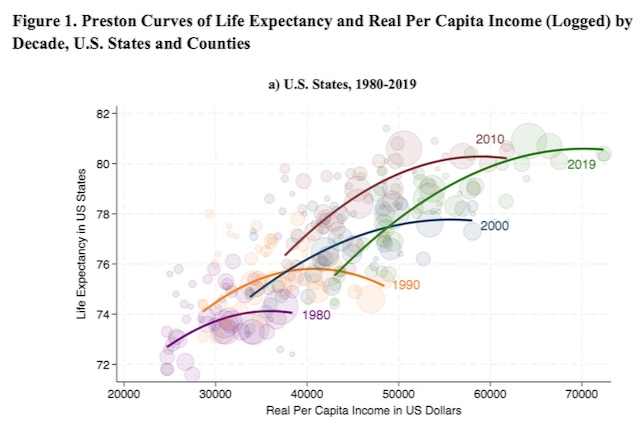
source: Khanna et al, NBER
The authors don’t identify the causes for this surprising disconnect, but rather focus their diagnosis at an even higher level of the system: “a weakening of institutional and social translation: the failure of a rich society to convert available resources, flexible advantages, and mortality-reducing knowledge into broadly shared longevity gains.” They also note that beyond the overall conclusion of a reduced capacity to translate resources into public health benefits, there is increasing inequality in that capacity among the different states and counties in the US.
Their diagnosis is analogous to Santulli’s, but at a higher, more general level. The failure to translate cardiovascular knowledge into population health gains is an illustrative example of a broader failure to convert resources, advantages and knowledge – across all diseases – into longevity gains. The emphasis on a society’s ability to translate resources, broadly speaking, into health gains is interesting because it implies a level of societal intentionality about that act of translation. It supposes that as a society gets richer it would seek to pursue greater health and longer lives for its residents. (To be fair, Samuel Preston, for whom the curves are named, showed that this is the typical result.) But whether this goal is overt and conscious, and whether it is pursued with clear intention is perhaps less obvious. It would also seem that how it is pursued matters quite a bit. In the US, we rely heavily on markets to activate any implicit preferences – the resources poured into medical research and development presumably reflect a societal desire for greater health and longevity, as do the billions spent on wellness trends. Yet our markets have also given us ultraprocessed foods, car dependency, 24/7 entertainment and other seemingly highly valued goods and services that let’s just say “detract” from population health gains. Santulli argues that what’s missing is “implementation, integration and alignment.” The invisible hand creates new wealth, new knowledge and other resources that can be translated into health progress, but the lack of implementation, integration, alignment and, to be frank, coherent strategy to do so, calls out for a more visible hand – from government.
We are seemingly trapped in a loop of dysevolution – we get better at managing disease, but we frequently reinforce and amplify the conditions that create it in the first place. The pattern would appear to be a stable, steady state. As such, a lot of institutions benefit from the status quo. Breaking this loop will require clear intention, different thinking and a willingness to challenge those benefits.
Read the full newsletter.