
Newsletter | New Food Guidelines: The Steaks Are High
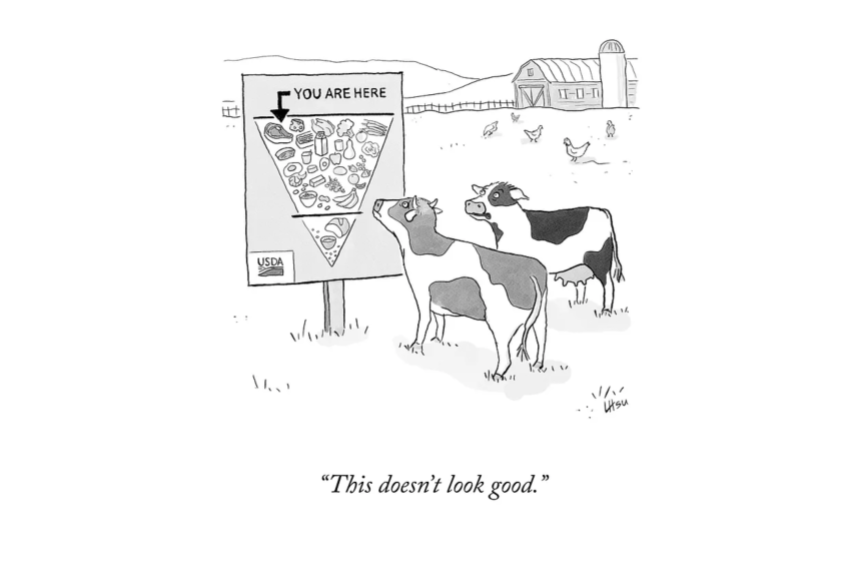
cartoon by Lynn Hsu
The much anticipated update of the federal Dietary Guidelines for Americans came out earlier this month. There was much to like, such as stronger language on added sugars and a caution against eating "highly processed” (read “ultraprocessed”) foods, much that’s been controversial (more protein, more meat, and more saturated fats) and even some puzzles (one can’t actually meet the protein recommendations without straying afoul of the recommended saturated fat ceiling).
HHS Sec’y Robert F. Kennedy Jr. and USDA Sec’y Brooke Rollins touted the removal of “woke” ideology (which apparently had something to do with a “war on protein” and the recognition that people’s diets might be affected by their means) and a return to science that wasn’t captured by special interests (although it turns out that the advisors behind the guidelines had plenty of ties to the beef, pork and dairy industries.)
If you want to dig deeper, there are some good general roundups, such as “Making sense of our new dietary guidelines — and what comes next” from Helena Bottemiller Evich’s always insightful Food Fix newsletter and Marion Nestle’s 7-part blog series, beginning with “The MAHA 2025-2030 Dietary Guidelines have arrived: Cheerful, Muddled, Contradictory, Ideological, Retro.” There have been takes on the economics of the advice, notably from STAT – “MAHA says its new food pyramid is affordable and healthy. We asked experts” – and from Bulwark’s Jared Poland, who, in the spirit of the late Morgan Spurlock, attempted to feed himself for three days on $3 per meal (which Sec. Rollins had claimed was all it took to eat healthy).
The Guidelines are a focal point in nutrition policy – they come out every five years and represent both the evolution of the science and the communication of the science. From a policy perspective, they matter – as is pointed out in Food Fix– because they influence regulations for school meals and for programs like SNAP.
But in reality, they have little influence on what most Americans eat. And we could point out that the first edition of the Guidelines came out 45 years ago and national obesity rates have more than doubled – from under 20% to more than 40% – since then. (Of course, RFK Jr. might argue that that’s because they’ve been the wrong guidelines all this time.)
Ultimately the Dietary Guidelines for Americans are a relatively modest intervention. Believing that these guidelines will ultimately make people significantly healthier requires believing that if you tell people what’s healthy to eat, more people will develop and maintain healthy diets. But that’s not what drives most people’s eating habits.
The Pew Research Center surveyed Americans last year in order to understand how rising grocery prices were affecting people diets and their report, Americans on Healthy Food and Eating, reminds us what we know from experience. While most Americans are aware of the importance of healthy diets, health ranks third on their list of important factors – behind taste and price and just barely ahead of convenience.
The Guidelines will fail – and have consistently failed – to move the needle enough because they don’t go anywhere near far enough to shift the food environment within which people attempt to find the best balance among taste, affordability, convenience and health. Whatever the Guidelines say about added sugars, we will still have aisles stocked with sodas and checkout lanes with candy. We still won’t be able to drive 5 miles without passing a dozen fast food restaurants. And more than 50% of the items in our supermarkets will still be ultraprocessed foods.
In the second post in her series, “The MAHA Dietary Guidelines II: Personal Responsibility vs. Public Health Policy,” Marion Nestle offers a key insight:
“This approach leaves it entirely up to you to make healthful food choices, never mind that if you try to eat healthfully, you are fighting the entire food system on your own.
“The goal of food companies—even those selling real food—is to get you to buy as much of it as possible, regardless of how their products affect your health or that of the planet.
“Given this administration’s destruction of the public health system in America, you really are on your own.
“The groups in America who eat most healthfully are educated; have decent jobs, money, and resources; have homes with functioning kitchens; can cook; live in safe neighborhoods with grocery stores; and have access to affordable health care. That’s what public health is about.
“If the government leaves it to you to “do your own research” and fight the food system on your own, it is saying it has no responsibility for creating a food environment that can help you eat and enjoy real food.
“It’s all on you.”
We have a food system that, quite simply, has different goals than the health of the public. Towards the end of last year, The Lancet published a series of papers on ultra-processed foods (UPFs). The papers covered the state of the science, the policy opportunities and the role of the food industry – and are very hard-hitting. To their credit, RFK Jr. and his colleagues have also focused on the dangers of UPFs – and the Guidelines do make advances in this respect – but they might be missing the point. the Lancet argues that the real impact of UPFs is in what they have displaced:
“The global rise of UPFs in human diets is structurally and commercially driven, reflecting the growing economic and political power of the UPF industry in food systems. The high profitability of UPFs—achieved through cheap commodity inputs, processing technologies, and powerful marketing—fuels the industry's growth, restructuring food systems in ways that displace other types of foods and promoting dietary patterns linked with chronic disease.”
“It is the overall UPF dietary pattern, whereby whole and minimally processed foods are replaced by processed alternatives, and the interaction between multiple harmful additives, that drives adverse health effects.”
It's less about getting people to avoid certain ingredients or additives common to UPFs and more about the need for a fundamental transformation in how food is produced, marketed and sold. We can offer nutrition advice to the public all we want – and of course we should – but absent large-scale policy change to the food environment, we will continue to grapple with the diseases that come from unhealthy diets.
We’ll leave you with a quote from the late Paul Farmer, brought to our attention by Ramon Llamas, who shared it in his essay on “Designing for Agency”:
“There is nothing wrong with underlining personal agency, but there is something unfair about using personal responsibility as a basis for assigning blame while simultaneously denying those who are being blamed the opportunity to exert agency in their lives.”
Read the full newsletter.