
Newsletter | How to Better Spend $5 Trillion
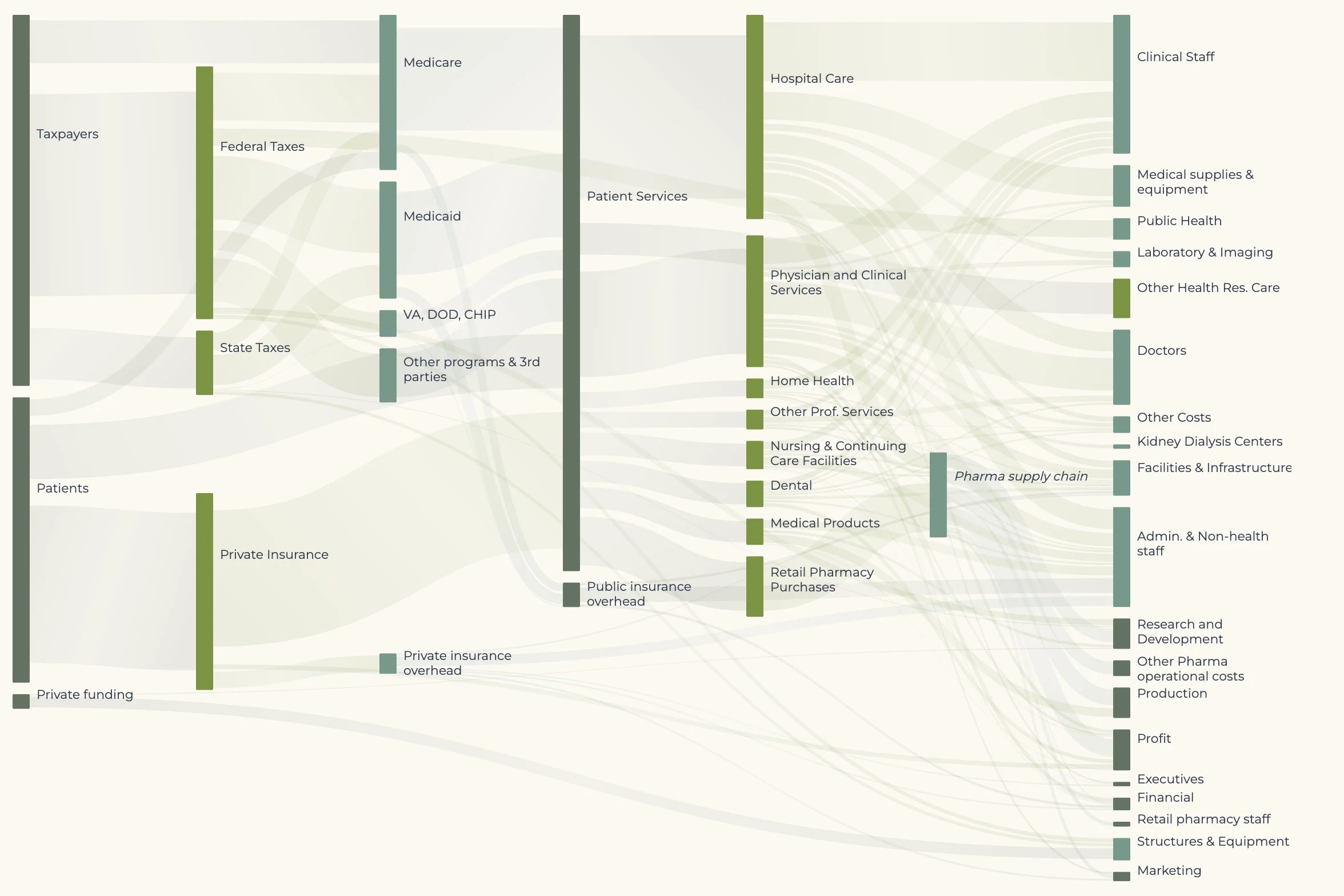
We all know the statistics. The United States spends $5 trillion on health care each year - and 80% of it passes through private and government insurance into patient care, hospitals, and prescription drugs. This is the disease business, and it is a staggering monument to misplaced priorities and reactive inefficiencies.
We also all know that, were the healthcare system to be rebuilt anew, far more resources would go to disease prevention and health promotion - structures and systems to help people maintain their health, rather than seek care once they get sick.
But that’s hypothetical. In actual practice, the US spends just 3% of that $5 trillion on preventing disease or systems to measure the public’s health (largely on funding for the CDC and FDA, and even that measly amount is being slashed).
(To dig in on where the money comes and goes, Juhan Sonin’s GoInvo design studio created the above chart in an amazing interactive visualization - highly recommended.)
For those of us who care about public health - hell, those of us who care about spending $5 trillion prudently - this is an upside-down disaster, an all-but-guarantee that the US will spend ever more money on healthcare and gain ever less health. It is, at once, both an absurdity…and also makes perfect sense.
It makes sense because public health is too much an abstraction - an intangible framework for pursuing better human health, when that’s not at all how humans work. Humans go about their lives, plenty busy and plenty happy not to care about their health… until something goes wrong. And when that happens, well, that’s what we have insurance, hospitals, and drugs for. So that’s what we spend our money on.
Until public health and its toolbox - prevention, promotion, policy, populations - is somehow less abstract and more compelling to both the public and our politicians, it seems inevitable that the money will largely flow elsewhere.
When Steve and I started Building H several years ago, we saw the project, in part, as a new way to make public health more compelling. We wanted to account for causes and bring greater accountability to the companies that actually profit from poor health. We try to tell a new story about why disease happens, and who might be accountable for it - and thereby make public health a little more tangible.
Today marks the debut of another effort to tell a more compelling story. It’s a new podcast called Drug Story, and it’s my attempt to help people care about public health, even without them even knowing it.
Every episode uses one drug to explore one disease, from obesity to heart disease, from insomnia to depression. We explore why these conditions have exploded in prevalence in recent decades - often the result of the world we’ve built. And each episode considers the trade-offs and consequences of treating so many diseases with so many drugs.
Drug Story tries to acknowledge the good that so many drugs have done for so many. But it also reckons with how drugs don’t necessarily solve the larger issues that continue to drive so much disease in the 21st century. And drugs - which account for more than 10% of that $5 trillion in US healthcare spending - bring their own consequences.
For readers of this newsletter, you can consider Drug Story a sibling project of Building H, another effort to use stories and evidence to remind people that public health matters, and that our current mode of operations won’t solve the larger problems we confront.
The podcast is the fruit of the past couple years I’ve spent as an impact fellow at the UC Berkeley School of Public Health (gratitude to Claudia Williams, Fred Dillon, Molly Woerner, and the whole Social Impact team). There are only 10 episodes in this first season (making public health fun is a lot of work!), so I am hoping the Building H community will show up and support the show.
The first episode is about the EpiPen - but it’s really about how a misguided public health recommendation contributed mightily to an epidemic of food allergies, and how the EpiPen was in the right place at the right time to make the most of that error. It’s a fun listen, I promise.
Please subscribe, download, review, and recommend the show on Apple, Spotify, or Substack.
Thanks for reading - and listening!